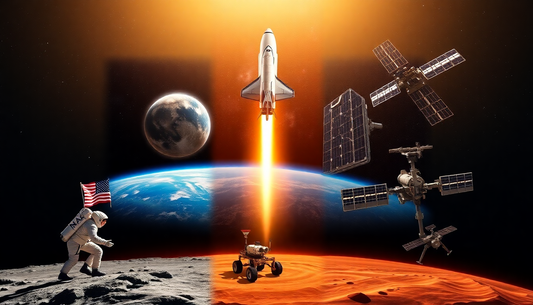

Why Are We So Fascinated by Space?
The human fascination with space is one of the most profound and enduring aspects of our species. From the moment our ancestors first gazed up at the night sky and wondered about the stars, we have been captivated by the vast cosmos that surrounds our small planet. This fascination has driven us to develop increasingly sophisticated technologies, to ask deeper questions about our place in the universe, and to push the boundaries of human exploration and understanding. But what is it about space that captures our imagination so completely? Why do we spend billions of dollars on space exploration, dedicate our lives to studying the cosmos, and dream of traveling to distant worlds? The answers to these questions reveal something fundamental about human nature and our deepest desires.
The Historical Roots of Our Cosmic Curiosity
The human fascination with space is not a modern phenomenon. Throughout history, cultures around the world have looked to the heavens with wonder and reverence. Ancient civilizations such as the Egyptians, Greeks, Babylonians, and Chinese developed sophisticated systems of astronomy, mapping the stars and planets visible to the naked eye. These early astronomers were driven by a combination of practical needs and pure curiosity. They used the stars for navigation, for tracking the passage of seasons, and for religious and spiritual purposes. Yet beyond these practical applications, there was always an element of pure wonder—a desire to understand the nature of the celestial realm and humanity's relationship to it.
The ancient Greeks made remarkable strides in understanding the cosmos. Philosophers like Aristotle and Ptolemy developed models of the universe that, while ultimately incorrect, represented serious attempts to understand the structure of the cosmos. These early thinkers recognized that the Earth was spherical, calculated its circumference with surprising accuracy, and proposed that the celestial bodies moved according to mathematical principles. This combination of observation, reasoning, and imagination laid the groundwork for the scientific revolution that would come centuries later.
During the Middle Ages, while European scientific progress slowed, Islamic scholars made tremendous advances in astronomy. Observatories were built, star catalogs were created, and mathematical models of planetary motion were refined. This work preserved and expanded upon the knowledge of the ancients, ensuring that when the European Renaissance arrived, there was a rich foundation of astronomical knowledge to build upon.
The invention of the telescope in the early seventeenth century marked a turning point in human understanding of space. Galileo's observations through his telescope revealed that the Moon had mountains and valleys, that Jupiter had moons orbiting it, and that Venus showed phases like our own Moon. These discoveries shattered the prevailing view of a perfect, unchanging celestial realm and suggested that the heavens operated according to the same physical laws as the Earth. This realization was revolutionary and deeply unsettling to many, yet it also opened new avenues for exploration and understanding.
The Scientific Revolution and the Birth of Modern Astronomy
The scientific revolution of the sixteenth and seventeenth centuries transformed humanity's relationship with space. Copernicus proposed that the Sun, not the Earth, was at the center of the solar system. Kepler discovered the laws of planetary motion. Newton developed the theory of gravity, which explained not only why objects fall to the ground but also why planets orbit the Sun. These breakthroughs were not merely academic exercises; they represented a fundamental shift in how humans understood their place in the universe.
With each discovery, the universe seemed to grow larger and more complex. What had once been thought of as a relatively small, orderly cosmos revealed itself to be vast beyond imagination. The stars were not mere points of light on a celestial sphere but distant suns, potentially with their own planetary systems. The Milky Way, which had been a mysterious cloudy band across the sky, was revealed to be a vast collection of billions of stars. And beyond the Milky Way lay other galaxies, stretching away into the depths of space.
This expanding understanding of the universe had profound philosophical implications. If the Earth was not the center of the cosmos, what did that mean for humanity's significance? If the universe was so vast and ancient, what was our role in it? These questions troubled many people, yet they also inspired a sense of wonder and a desire to understand more. The scientific study of space became a way of grappling with these fundamental questions about existence, meaning, and our place in the grand scheme of things.
The Technological Revolution and Space Exploration
The twentieth century witnessed an unprecedented acceleration in space exploration. The development of rockets, initially as weapons during World War II, eventually became the means by which humans could escape Earth's gravity and venture into space. The Space Race between the United States and the Soviet Union during the Cold War drove rapid technological advancement and captured the imagination of people around the world.
The launch of Sputnik in 1957 shocked the world. A human-made object was now orbiting the Earth, proving that space travel was possible. Just a few years later, Yuri Gagarin became the first human in space, orbiting the Earth in 1961. The achievement was celebrated globally, and it sparked a surge of interest in space exploration. Schools began teaching more science, young people dreamed of becoming astronauts, and governments invested heavily in space programs.
The Apollo program represented the pinnacle of this era of exploration. The goal of landing humans on the Moon seemed impossibly ambitious, yet through determination, ingenuity, and enormous resources, it was achieved. When Neil Armstrong and Buzz Aldrin walked on the Moon in 1969, millions of people around the world watched in awe. This achievement represented the culmination of centuries of curiosity about space and demonstrated the remarkable capabilities of human technology and determination.
The Space Race eventually cooled, but space exploration continued. Space stations were built, allowing humans to live and work in orbit for extended periods. Robotic probes were sent to explore the planets and moons of our solar system. Telescopes were launched into space, allowing us to see deeper into the universe than ever before. Each mission brought new discoveries and new questions, fueling continued interest in space exploration.
The Psychological Appeal of Space
Beyond the historical and scientific reasons for our fascination with space, there are deep psychological factors at play. Space represents the ultimate frontier, a realm of infinite possibility and mystery. In an increasingly mapped and understood world, space remains largely unexplored and unknown. This appeals to something fundamental in the human psyche—the desire to explore, to discover, and to push beyond known boundaries.
The vastness of space also provides perspective. When we contemplate the scale of the universe, our everyday problems and concerns seem to shrink in significance. This can be both humbling and liberating. Many astronauts have reported that seeing the Earth from space—a small, fragile blue marble floating in the darkness—profoundly changed their perspective on life and humanity's place in the cosmos. This shift in perspective, sometimes called the "overview effect," can inspire a sense of unity and common purpose among all humanity.
Space also appeals to our sense of wonder and awe. These are powerful emotions that connect us to something larger than ourselves. In a world that often feels mundane and predictable, space represents mystery and the unknown. The possibility of discovering new worlds, encountering extraterrestrial life, or understanding the fundamental nature of reality drives our curiosity and imagination.
Furthermore, space exploration taps into our desire for achievement and accomplishment. Reaching for the stars is a way of demonstrating human capability and pushing the limits of what is possible. Each successful mission, each new discovery, represents a triumph of human ingenuity and determination. This sense of achievement is deeply satisfying and motivates continued investment in space exploration.
The Search for Extraterrestrial Life
One of the most compelling reasons for our fascination with space is the possibility of discovering extraterrestrial life. The question of whether we are alone in the universe is one of the most profound questions humanity can ask. For centuries, this was purely a matter of speculation and philosophy. But with the development of modern astronomy and astrobiology, the search for extraterrestrial life has become a serious scientific endeavor.
The discovery of thousands of exoplanets—planets orbiting stars other than our Sun—has suggested that planetary systems are common throughout the universe. Some of these exoplanets are in the "habitable zone," the region around a star where conditions might be suitable for life as we know it. This has led many scientists to believe that the conditions necessary for life might be widespread in the universe.
The search for extraterrestrial intelligence, or SETI, represents humanity's attempt to detect signals from intelligent civilizations elsewhere in the cosmos. While no confirmed signals have been detected, the search continues, driven by the tantalizing possibility that we might not be alone. The discovery of even microbial life on another world would be revolutionary, fundamentally changing our understanding of biology and our place in the universe.
The possibility of extraterrestrial life captures our imagination in ways that purely scientific considerations cannot fully explain. It speaks to a deep human desire for connection and the hope that we are part of a larger cosmic community. The idea of encountering an alien civilization, of learning from them and sharing knowledge, represents a kind of ultimate human adventure.
The Spiritual and Philosophical Dimensions
For many people, fascination with space has spiritual and philosophical dimensions. The contemplation of the cosmos can inspire a sense of transcendence and connection to something greater than ourselves. Many religious and spiritual traditions have incorporated space and the heavens into their worldviews, seeing the cosmos as a manifestation of divine creation or cosmic consciousness.
The vastness and complexity of the universe raise profound philosophical questions. How did the universe begin? What is the nature of time and space? Are there other dimensions or realities beyond what we can perceive? These questions have occupied philosophers and scientists for centuries, and they continue to inspire wonder and contemplation.
Space exploration also raises important questions about human values and priorities. Why do we invest so much in reaching for the stars when there are pressing problems here on Earth? This question reflects a tension in human nature between our desire to explore and expand our horizons and our responsibility to address immediate needs and suffering. Yet many argue that space exploration and addressing earthly problems are not mutually exclusive. The technologies developed for space exploration often have practical applications that improve life on Earth. Moreover, the sense of unity and common purpose that space exploration can inspire might help us address global challenges more effectively.
The Role of Science Fiction
Science fiction has played a crucial role in shaping and sustaining our fascination with space. From Jules Verne's "Journey to the Center of the Earth" and "From the Earth to the Moon" to contemporary works like "The Martian" and "Interstellar," science fiction has allowed us to imagine possibilities and explore scenarios that inspire real-world exploration and innovation.
Science fiction serves multiple functions in relation to our fascination with space. It provides a canvas for exploring "what if" scenarios, allowing us to imagine futures and possibilities. It can inspire young people to pursue careers in science and engineering. It also allows us to work through anxieties and hopes about the future in a safe, imaginative space. Many of the technologies we now take for granted were first imagined in science fiction before being developed in reality.
The influence of science fiction on space exploration is profound and well-documented. Many astronauts and space scientists have cited science fiction as an inspiration for their careers. The vision of space exploration presented in works like "Star Trek" has influenced how we think about the future and our role in it. Science fiction has kept the dream of space exploration alive during periods when actual space exploration has slowed or faced budget cuts.
The Economic and Practical Benefits
While the fascination with space is often driven by wonder and curiosity, there are also significant practical and economic benefits to space exploration. The space industry has become a major economic sector, generating jobs and driving technological innovation. Satellite technology, developed for space exploration, has become essential to modern life, enabling global communications, weather forecasting, GPS navigation, and countless other applications.
The resources available in space—minerals, water, and potentially energy—represent a frontier for future economic development. As Earth's resources become more strained, the possibility of mining asteroids or extracting water from the Moon becomes increasingly attractive. While these activities are still largely in the realm of possibility rather than reality, they represent potential solutions to resource scarcity.
Space-based solar power, another concept that has long captured the imagination of engineers and scientists, could potentially provide clean, abundant energy to Earth. While the technology is not yet practical, research continues, driven by the potential benefits. These practical considerations add another dimension to our fascination with space—the recognition that space exploration is not merely about satisfying curiosity but also about ensuring humanity's long-term survival and prosperity.
The Challenge of Understanding Scale and Distance
One of the most profound aspects of space that fascinates us is the sheer scale and distance involved. The human mind evolved to understand distances measured in meters and kilometers, timescales measured in hours and years. The distances and timescales of space are so vast that they are almost incomprehensible.
The nearest star to Earth, Proxima Centauri, is about 4.24 light-years away. This means that light from that star takes over four years to reach us. If we were to travel there at the speed of our fastest spacecraft, it would take tens of thousands of years. The Milky Way galaxy contains an estimated 100 to 400 billion stars, and it is just one of billions of galaxies in the observable universe. When we contemplate these numbers, our minds struggle to grasp the enormity of it all.
This difficulty in comprehending scale is itself fascinating. It pushes the boundaries of human understanding and imagination. It forces us to develop new ways of thinking and visualizing. It reminds us of the limits of human perception and understanding, yet also of our remarkable ability to extend our knowledge through mathematics, physics, and technology.
The Role of Technology and Innovation
Our fascination with space has driven remarkable technological innovation. The development of rockets, spacecraft, life support systems, and countless other technologies required to explore space has pushed the boundaries of engineering and science. Many of these technologies have had applications far beyond space exploration.
The space program has driven advances in materials science, computer technology, medicine, and many other fields. Innovations developed for space exploration, such as water purification systems, advanced materials, and medical monitoring devices, have found their way into everyday use. The economic benefits of these technological spillovers are substantial and represent a significant return on investment in space exploration.
Moreover, the challenge of space exploration continues to inspire innovation. As we set new goals—returning to the Moon, establishing a permanent human presence on Mars, exploring the outer planets—we must develop new technologies and solve new problems. This process of innovation and problem-solving is itself a source of fascination and pride for many people.
The Future of Space Exploration
As we look to the future, our fascination with space shows no signs of diminishing. New space agencies from countries around the world are developing their own space programs. Private companies are entering the space industry, developing new technologies and business models for space exploration. Plans are being made for returning humans to the Moon, establishing a permanent lunar base, and eventually sending humans to Mars.
The discovery of potentially habitable exoplanets has reinvigorated the search for extraterrestrial life. Advanced telescopes, both ground-based and space-based, are providing unprecedented views of the universe, revealing its structure and history in greater detail than ever before. The James Webb Space Telescope, launched in 2021, is already making discoveries that are reshaping our understanding of the early universe.
The possibility of discovering extraterrestrial life, whether microbial or intelligent, remains a powerful driver of space exploration. The search for life beyond Earth represents one of the most profound scientific endeavors of our time. It combines the practical tools of science with the deepest questions about existence and our place in the universe.
The Unifying Power of Space Exploration
One of the most remarkable aspects of space exploration is its potential to unite humanity. Despite political divisions, economic disparities, and cultural differences, space exploration has the power to inspire people across all boundaries. The image of the Earth from space—a single, unified world without borders—has become a symbol of human unity and shared destiny.
International cooperation in space exploration has increased significantly in recent decades. The International Space Station, a joint project of multiple nations, represents a remarkable example of cooperation and shared purpose. Scientists and engineers from different countries work together toward common goals, transcending political and cultural differences.
This unifying power of space exploration is particularly important in a world facing global challenges such as climate change, resource scarcity, and social inequality. The sense of common purpose and shared identity that space exploration can inspire might help us address these challenges more effectively. The recognition that we all share a single planet and a common future can motivate cooperation and collective action.
The Psychological Impact of Space Exploration
The psychological impact of space exploration on individuals and society is profound and multifaceted. For individuals who work in space exploration—astronauts, engineers, scientists—the experience can be transformative. Astronauts who have traveled to space often report that the experience changed their perspective on life and their understanding of humanity's place in the universe.
For society as a whole, space exploration provides a source of inspiration and hope. In times of difficulty or uncertainty, the achievements of space exploration remind us of human capability and the possibility of accomplishing great things. The successful landing of rovers on Mars, the discovery of water on the Moon, the detection of gravitational waves—these achievements represent triumphs of human knowledge and determination.
Space exploration also provides a counterbalance to the often negative news that dominates media coverage. While many news stories focus on conflict, disaster, and suffering, space exploration represents human achievement, cooperation, and the pursuit of knowledge. This positive narrative can inspire hope and motivation, particularly in younger generations.
The Educational Impact
Space exploration has had a significant impact on education and the development of scientific literacy. The excitement and wonder associated with space exploration motivates young people to pursue careers in science, technology, engineering, and mathematics (STEM). The visibility of space exploration in media and popular culture keeps these fields in the public consciousness and makes them seem exciting and relevant.
Educational programs related to space exploration, from planetarium shows to school curricula focused on astronomy and space science, help develop scientific understanding and critical thinking skills. The study of